Prices, hours and rules checked against the official pages of the Bavarian Palace Administration and the Ticket Center Hohenschwangau. The booking page always has the final word.
Neuschwanstein Castle stands in the municipality of Schwangau, above the village of Hohenschwangau, about 120 km south-west of Munich and four kilometres from Füssen. You do not need a car: the train and the bus are timed to connect, and the Bayern-Ticket keeps the cost down. Drivers need to think about parking and about the road closure through Schwangau. Whichever way you arrive, the castle itself is 1.5 km above the village, and that last climb has to be done by everyone, before the time printed on the ticket.
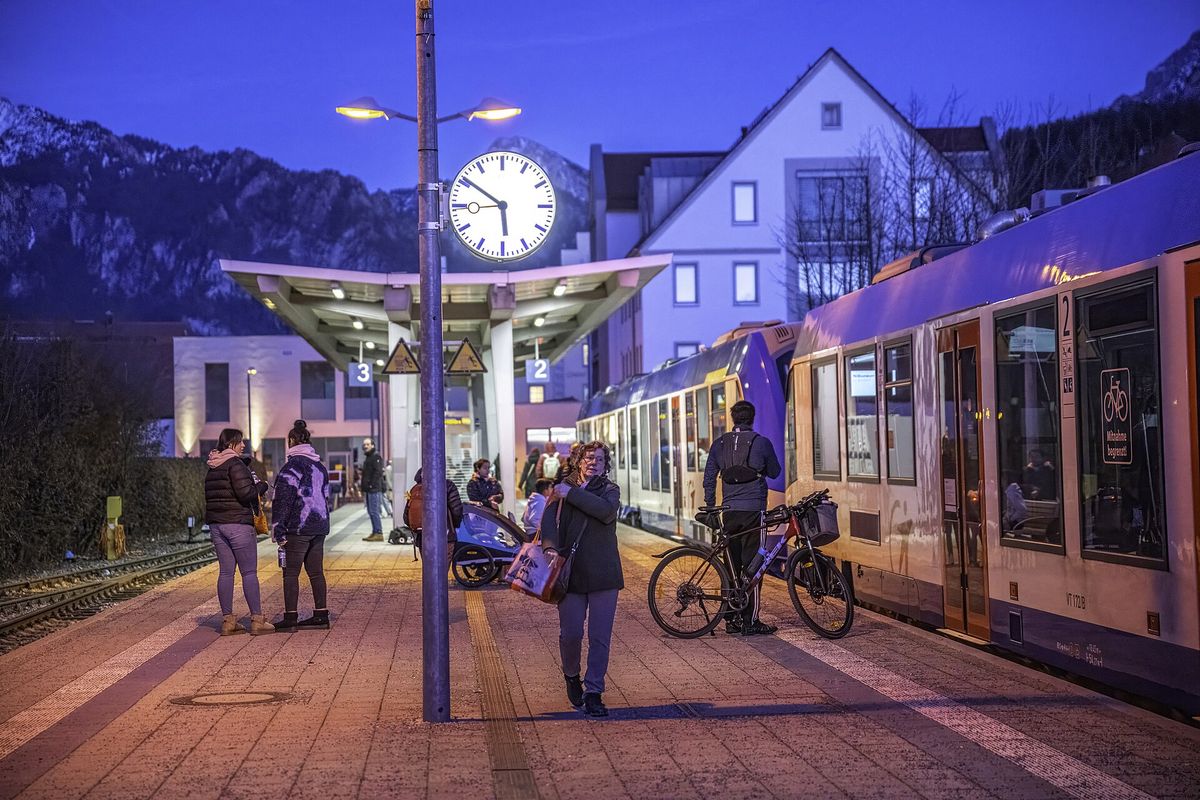
Munich to Neuschwanstein by train and bus
Regional trains leave Munich Hauptbahnhof for Füssen about once an hour; the journey takes around two hours, direct on some services and with a change at Buchloe on others. From Füssen station, bus 73 (towards Steingaden/Garmisch) or bus 78 (towards Schwangau) takes about ten minutes to the "Hohenschwangau Neuschwanstein Castles" stop; the buses wait for the trains. The Bayern-Ticket gives a day of unlimited travel on Bavarian regional trains and local buses: from €32 for one person, €10 for each additional traveller up to five, valid from 9:00 on weekdays and all day on Saturdays and Sundays. For two people the round trip therefore costs less than one castle ticket with fees. Buy it at the station machines or in the DB Navigator app; seats cannot be reserved on regional trains, so board early in summer. Note the 9:00 rule: on a weekday the first train you can use with a Bayern-Ticket is the one leaving after 9:00, which puts you at the castle around midday, so book a slot from about 13:00 onwards.
By car
From Munich take the A7 motorway towards Füssen and then the B17 to Schwangau: an hour and a half to two hours in normal traffic. Hohenschwangau has paid car parks P1 to P4; P4 is the closest to the Ticket Center and all of them fill up by mid-morning in summer. Cars cannot drive up to the castle, and stopping on the village streets is not allowed. Until about mid-December 2026 the main road through Schwangau is closed and the signposted detour runs via Hohenschwangau: five to ten minutes extra, and satnavs do not always know about it. From Austria, approach via the Fernpass and Reutte, half an hour from the castle. From Stuttgart or Frankfurt the A7 brings you straight to Füssen; from Salzburg or Innsbruck the Alpine route via Garmisch-Partenkirchen is slower but far prettier.
From Munich Airport
There is no direct link. Take the S-Bahn (S1 or S8) to Munich Hauptbahnhof, about 45 minutes, and then the regional train to Füssen; allow three and a half hours door to door. By hire car it is about two hours via the A99 ring road and the A96 or A7. For a first day in Germany a tour from Munich with a central pick-up is the least stressful way to do it.
With an organised tour
If you would rather not watch timetables, a day trip from Munich picks you up in the city centre, brings a guide, has a castle slot reserved and often stops at Linderhof or Oberammergau on the way. It costs more than the train-plus-ticket combination but removes the sold-out risk and the connections. Details and an honest comparison are on the tours from Munich page.
Tours from Munich on GetYourGuide
From the Ticket Center to the castle: the climb
| Option | Time | Notes |
|---|---|---|
| On foot | 30-40 minutes | paved road, uphill the whole way; hard with a pushchair, can be icy in winter |
| Shuttle bus | about 10 min + 10-15 min walk | runs to the 'Jugend' viewpoint near the Marienbrücke, then downhill to the gate; separate fare, does not run in snow and ice |
| Horse-drawn carriage | about 20 min + 5 min walk | drops you about 300 m below the gate; separate fare, long queues in high season |
| From the Marienbrücke | +10 minutes | downhill path from the bridge to the castle gate; the bridge can be closed in winter |
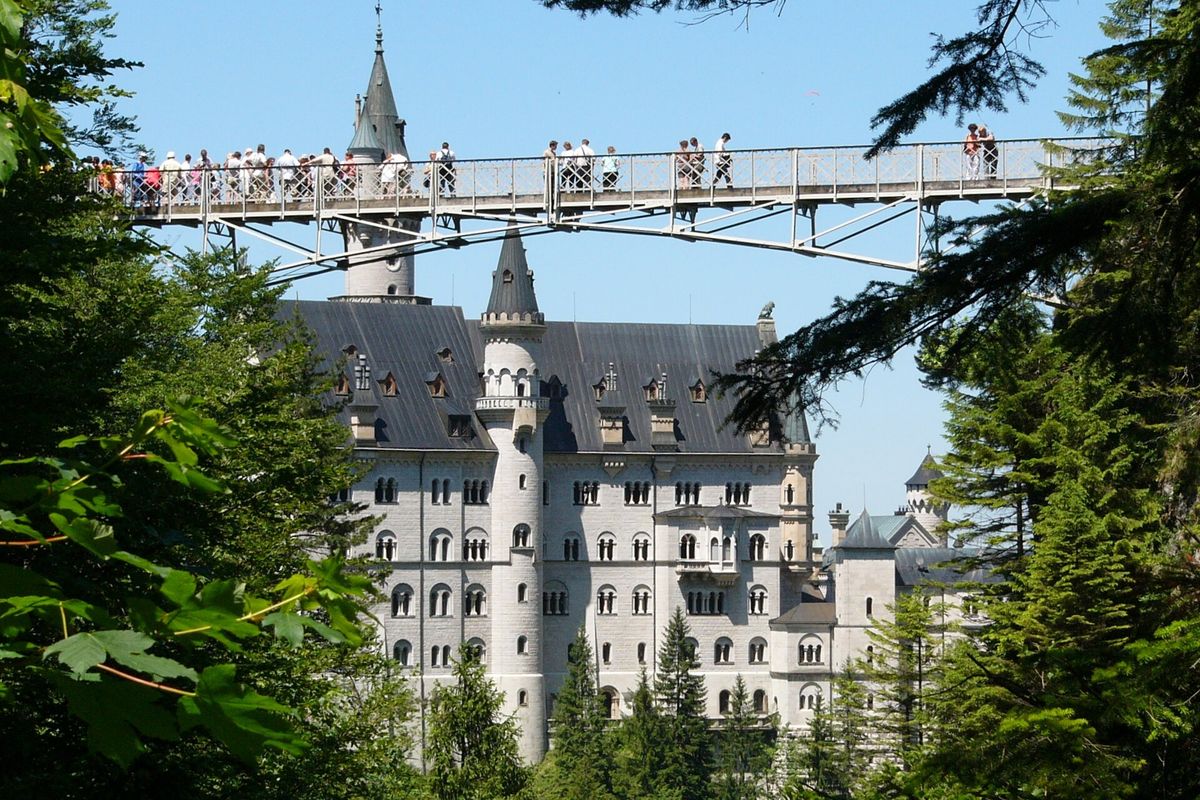
The bus does not go to the castle but to the Marienbrücke area, which is the best order anyway: photograph the castle from the bridge first, then walk down to the entrance. For the way back, the Pöllat gorge path is the most spectacular route but is open only in summer and in dry weather.
From Füssen, Garmisch and Austria
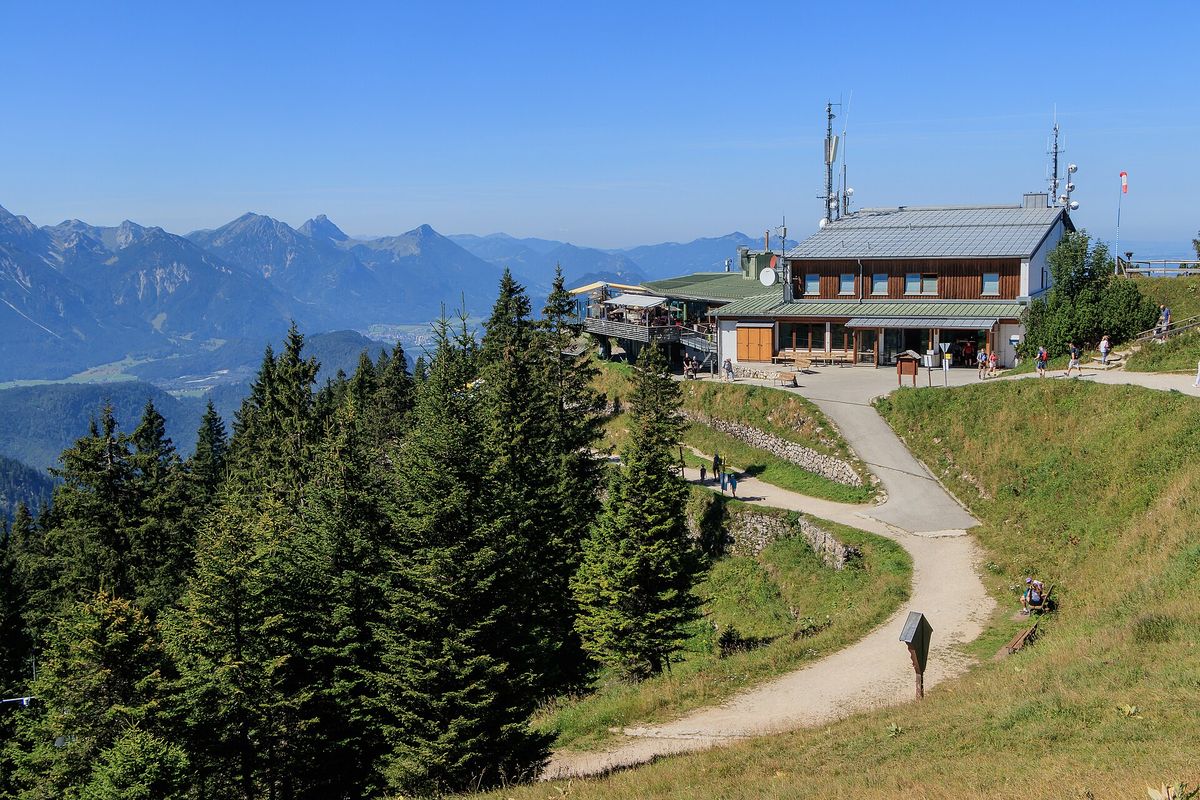
From Füssen the 73 and 78 buses take ten minutes; on foot, the walk around the Alpsee is two hours and lovely in good weather. From Garmisch-Partenkirchen, bus 73 via Oberammergau and Steingaden takes about an hour and a half and passes the Wieskirche on the way. From Innsbruck, the Fernpass drive is two hours; by train via Garmisch it is half a day. From Reutte in Tyrol, the castle is half an hour by car or by local bus.
Frequently asked questions about getting there
How long is the train from Munich to Neuschwanstein?
About two hours to Füssen, plus ten minutes by bus to Hohenschwangau, then 15-40 minutes up to the castle. Door to door, allow three hours.
Is the Bayern-Ticket valid on the bus?
Yes, on buses 73 and 78 and the local services around Hohenschwangau. It is not valid on the shuttle bus up to the castle, which has its own fare.
Where do I park?
In car parks P1 to P4 in Hohenschwangau, for a fee. P4 is the closest to the Ticket Center. Expect to pay the all-day rate.
Can I get up to the castle with a pushchair?
The road is steep but paved; the pushchair cannot go inside the castle and there are no lockers. A soft baby carrier is the practical answer.
Does the shuttle bus run in winter?
In snow and ice both the bus and the carriages stop, and the only way up is on foot. Add time to your plan.
Is a day trip from Munich worth it if I have no car?
Yes: the ticket is reserved, the pick-up is central and the connections are not your problem. The train is cheaper but needs a 9:00 start and a watchful eye on the return.
Sort out transport and the ticket together
Coming from Munich without a car? A day trip with the ticket included settles the train, the bus and the castle slot in one booking.
Tours from MunichEntry ticketsDistances from the castle
Straight-line distances from Neuschwanstein Castle.